
What Daily Life in Paris Actually Feels Like After the Tourist Phase Ends
The City You Thought You Knew
Most people who move to Paris have visited before. Some have visited many times. They arrive with a version of the city already formed in their imagination — shaped by long weekends, summer holidays, guidebook recommendations, and the particular quality of attention that travel produces. That version of Paris is real. But it is not the city you inhabit when you actually live there.
The tourist phase does not end on the day you move in. It fades gradually, over weeks and sometimes months, as the extraordinary becomes ordinary and the city stops performing for you and simply becomes the place where you live. What replaces the tourist experience is something quieter, more textured, and — for most people who have been honest with themselves about what they were looking for — considerably more satisfying.
The Rhythm of a Parisian Week
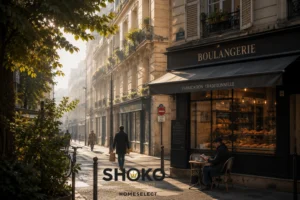
Daily life in Paris organises itself around rhythms that are immediately legible once you stop moving at tourist speed. The morning market on your street — which you walked past without stopping on your first weekend — becomes the place where you buy your vegetables on Wednesday and Saturday. The boulangerie two doors down becomes yours in a way that no guidebook can manufacture: the owner recognises you, knows your order, and eventually stops asking.
The working week in Paris has its own texture. Lunch is still taken seriously in a way that surprises arrivals from North American or Northern European cities where desk lunches have become the norm. The two-hour midday pause is not universal, but the instinct toward it is — and the density of good, affordable restaurants within walking distance of virtually any central Paris address makes the ritual genuinely accessible rather than aspirational.
Evenings move differently too. The city does not empty after work the way some northern European capitals do. The terrasse culture — tables outside bars and restaurants that remain occupied well into the evening, in any weather that permits it — creates a persistent social texture to the streets that makes Paris feel inhabited in a way that lifts the quality of everyday life in ways that are hard to quantify but immediately felt.
The Administrative Reality
It would be dishonest to describe daily life in Paris without acknowledging the administrative dimension. France has a bureaucratic culture that is simultaneously comprehensive and occasionally impenetrable, and the process of establishing yourself as a resident — bank account, health insurance registration, tax identification, utilities, residency documentation — requires patience, attention to detail, and a tolerance for processes that do not always move at the speed you would prefer.
Most international arrivals encounter at least one administrative situation that produces genuine frustration. The requirement for paper documents in a digital age, the specific sequencing of steps that must be completed in the correct order, the occasional contradiction between what different officials tell you — these are real features of the experience, and pretending otherwise does not serve anyone.
What most established expats will also tell you is that it gets easier. Once the foundational administrative infrastructure is in place — once you have the bank account, the social security number, the mutuelle health top-up — the ongoing administrative demands of Parisian life are not materially different from those of any other major European city. The heavy lifting concentrates in the first six months and then largely resolves.
What the Neighbourhood Actually Gives You
One of the things that surprises international residents most about Paris is how neighbourhood-based daily life actually is. For a city of two million people in its core, Paris functions in remarkably local ways. The arrondissement you live in shapes your daily experience profoundly — the character of your streets, the density of your local commerce, the social profile of the people you encounter, and the particular pace at which your immediate environment operates.
Residents of the 7th describe a quieter, more institutional Paris — embassies, ministries, wide residential streets that feel unhurried even at peak hours. Residents of the 6th live amid a density of bookshops, galleries, and café tables that produces a particular quality of intellectual stimulation as part of the ambient texture of daily life. The 16th offers a greener, more residential experience that some find peaceful and others find too removed from the city’s energy. The 11th and 12th offer a younger, more neighbourhood-oriented daily life with excellent markets and a social dynamism that contrasts with the quieter western arrondissements.
Getting the neighbourhood right is not a secondary consideration. It is the decision that will shape your daily experience more than almost any other variable in your Paris life.
The Social Landscape for International Arrivals
Building a social life in Paris takes longer than it does in cities with more established expat networks and a more transactional approach to new relationships. Parisians are not cold — a characterisation that most long-term residents find both inaccurate and unfair — but they do not make friends quickly by the standards of, say, Anglo-Saxon cities where social openness is a cultural default.
The international community in Paris is substantial and well-organised. Networks of English-speaking residents — many of them long-established, with roots in the professional, academic, and cultural institutions that bring internationals to the city — provide an important social scaffolding during the early months. Professional networks, language exchange groups, neighbourhood associations, and the surprisingly rich calendar of cultural events that Paris produces year-round all offer access points to social connection that reward consistent engagement.
Most international residents who have been in Paris for two or more years describe a social life that has gradually deepened from the expat scaffolding of the early period into something more genuinely integrated with the city — a mix of international and French friendships that reflects the particular personal and professional world they have built there.
The Ordinary Beauty That Becomes Invisible and Then Returns
There is a phenomenon that almost every long-term Paris resident describes, usually with some combination of affection and self-awareness. In the early months, the beauty of the city is a constant presence — the light on the stone facades in the late afternoon, the view down a long boulevard toward a monument you cannot quite believe is simply there, the quality of the sky over the rooftops from your window. Then, as daily life takes over, this beauty recedes into background. You stop seeing it consciously.
And then it returns. Not as tourist spectacle but as something more intimate — a city that you know well enough now to appreciate in its details rather than its postcard moments. The specific quality of light in your street at a particular time of day. The building you pass every morning that you have finally learned enough architectural history to understand. The seasonal changes in the Luxembourg Garden that you have now observed through multiple cycles.
This is what daily life in Paris eventually produces for those who commit to it with genuine intention. Not the constant exhilaration of tourism, but something more durable: the particular pleasure of knowing a magnificent city from the inside.
If you are planning a move to Paris and want guidance on where to live and what to expect, Contact SHOKO to discuss how independent property guidance supports international arrivals from the very beginning.
Recommended Reads
1. What No One Tells You Emotionally About Moving to Paris — homefrance.eu
2. The First 30 Days After Moving to France — Expat Guide — homefrance.eu
3. Living in Paris as an Expat: Choosing Between the 7th, 8th and 16th Arrondissements — homefrance.eu
4. Why International Families Choose Certain Paris Neighborhoods — gtamarket.ca